

How to Mix Antiques with Contemporary Interiors — and Why It Works
Updated: Sep 3
There is a vessel in our latest Design Edit that has been in use for over a hundred years. A 19th-century bronze urli from Kerala, South India - originally a cooking vessel, passed between hands, carried through generations. It sits in Edit No. 5 not as a focal point, but as a quiet presence. It is the piece people ask about first. That is what antiques do. They carry something into a room that new objects simply cannot manufacture.
Antiques are art at its most honest
There is a version of interior design that treats objects as decoration — chosen for colour, for scale, to fill a shelf. And there is another version that treats objects as the point entirely - chosen because they are extraordinary in themselves, because they carry meaning, because no two are alike.
Antiques belong to the second category, almost by definition.
An 18th-century mahogany cabinet, a wardrobe made in Gansu province in 19th-century China, a pendant light shaped by an Art Deco craftsman in the 1930s, a flatweave rug woven in Sweden in the 1960s - each of these represents a level of making that the contemporary market rarely produces and almost never makes accessible. The maker had time. The materials were chosen carefully. The form was arrived at through tradition, through repetition, through the accumulated intelligence of everyone who made something like it before.
That is not something a factory can replicate. What you are holding when you hold a genuine antique is the distilled craft of its moment - specific to its place, its culture, its maker's hands. Irreproducible. And in a world where almost everything can be copied, scaled and delivered overnight, that irreproducibility is worth more than most people realise.
The problem with rooms that could belong to anyone
A space furnished entirely with new pieces tends to have a particular quality. Everything matches. Everything has that slight sheen of recent manufacture. The proportions are safe because they have been market-tested. The finishes are uniform because they come from the same production line. It reads well in a showroom. It rarely reads as a home.
What is missing is specificity - the evidence that a particular person made particular choices over time. That they found this piece somewhere unexpected. That they couldn't leave without it. The interiors that stay with you are always layered. They contain things that don't quite match, in the best possible way. Things with a story behind them. Things you couldn't simply order again.
There is a particular flatness to interiors assembled entirely from what is currently available. The same pieces appear in different configurations, in different cities, in homes that have nothing else in common. It is nobody's fault - the market produces what the market produces - but the result is a visual sameness that is genuinely difficult to escape if you are buying exclusively new.
Antiques are the most direct refusal of that sameness. They exist once. They have been somewhere, belonged to someone, served a purpose. When a piece like that enters a room, it changes the room's character entirely. It makes the room specific to the person who chose it.
The pieces — and what makes each one earn its place
The 18th-century mahogany cabinet
For the Hyde Park Gardens bathroom project, we sourced an 18th-century fine-quality mahogany cabinet through Vinterior. Georgian mahogany carries a particular density and warmth - the timber itself is different from anything produced today, grown slowly, cut carefully, finished by hand. In a bathroom context, a piece like this does something no contemporary vanity unit can: it makes the room feel as though it has always existed, as though the objects in it were chosen over decades rather than specified in a single briefing. The patina, the joinery, the proportions - all of it the product of a making culture that no longer exists at this level.

The Gansu wardrobe
A 19th-century wardrobe from Gansu province in northwestern China carries the regional craft tradition in every detail - the joinery, the painted surface, the proportions shaped by a furniture culture entirely distinct from European making. It is not a decorative object pretending to be furniture. It is furniture, built to last, that has lasted. That robustness reads in a room. Placed in a contemporary interior, it anchors the space in a way that no high-end new storage can replicate. The age is visible. That visibility is the point.

The bronze urli
The 19th-century bronze urli from Kerala is not decorative in the conventional sense - it was never intended to be. It is a functional vessel, deep and heavy, that has earned its presence through use rather than design intent. That history lives in the patina: a surface that is not uniform, that has the marks of time in a way no artificially aged finish can replicate. It sits in Edit No. 5 alongside contemporary pieces - handblown Murano glass sconces, a hand-woven wool rug, a granite side table - and it is the piece that makes the edit feel collected rather than curated.

The Art Deco clamshell pendant
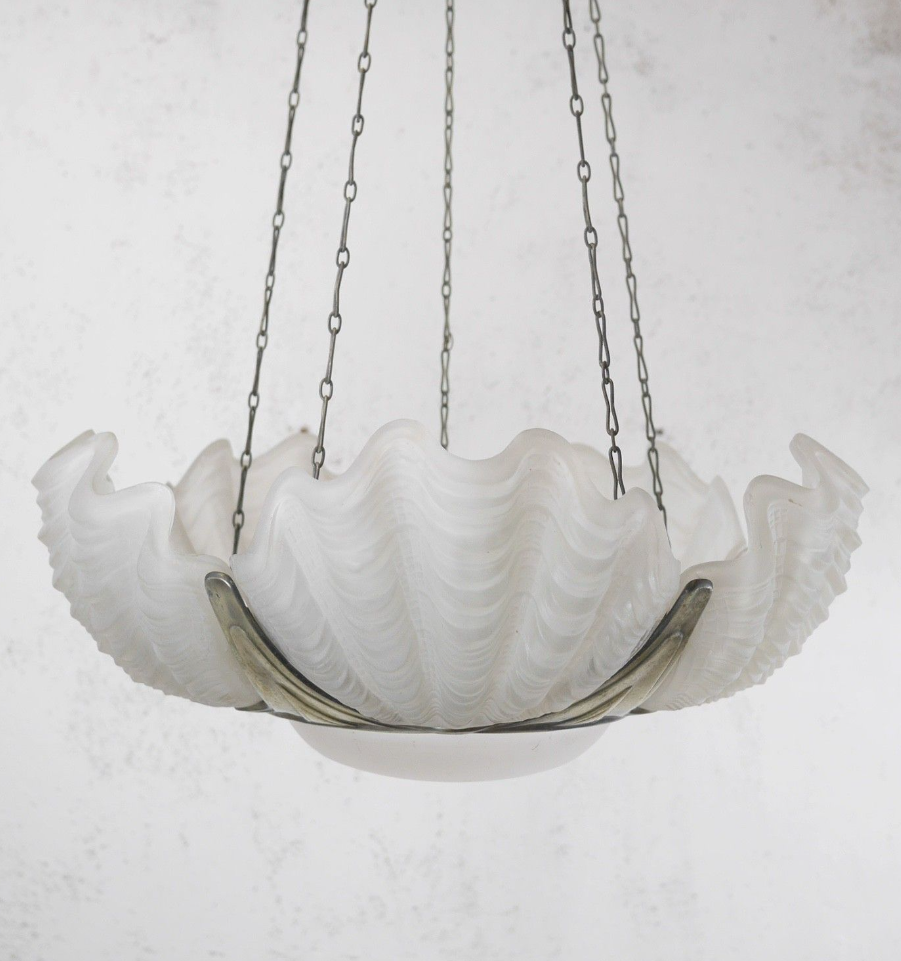
The colossal Art Deco clam shell pendant is an object that refuses to be ignored - and that refusal is entirely earned. Art Deco was a movement that understood drama and restraint simultaneously: the scale is bold, the form disciplined. A pendant like this, hung in a contemporary interior with clean walls and natural materials, becomes the room's defining decision. Everything else can be quieter because this piece carries the weight. It photographs as powerfully as it reads in a room, which is rare.
The Swedish mid-century wall mirror by G.T.
The Swedish mid-century mirror is a different proposition - understated, beautifully proportioned, the kind of piece that reveals itself slowly. Mid-century Scandinavian design has always understood the relationship between form and material: nothing superfluous, nothing arbitrary. A mirror like this, signed by its maker, is also a document - evidence of a specific person working in a specific tradition at a specific moment. That context doesn't disappear when it moves into a new interior. It deepens.

The 1960s Swedish flatweave rug
Flatweave rugs from this period are among the most undervalued antiques in interior design. The graphic quality of a 1960s Swedish flatweave - the geometry, the hand-mixed colours, the slight irregularities of the weave - is genuinely impossible to source new at any price. Reproduction flatweaves exist, and the gap between them and the original is immediately visible underfoot and in photographs. The real thing has a flatness and an honesty to it. It grounds a room without competing with anything above it.

The Murano glass sconces
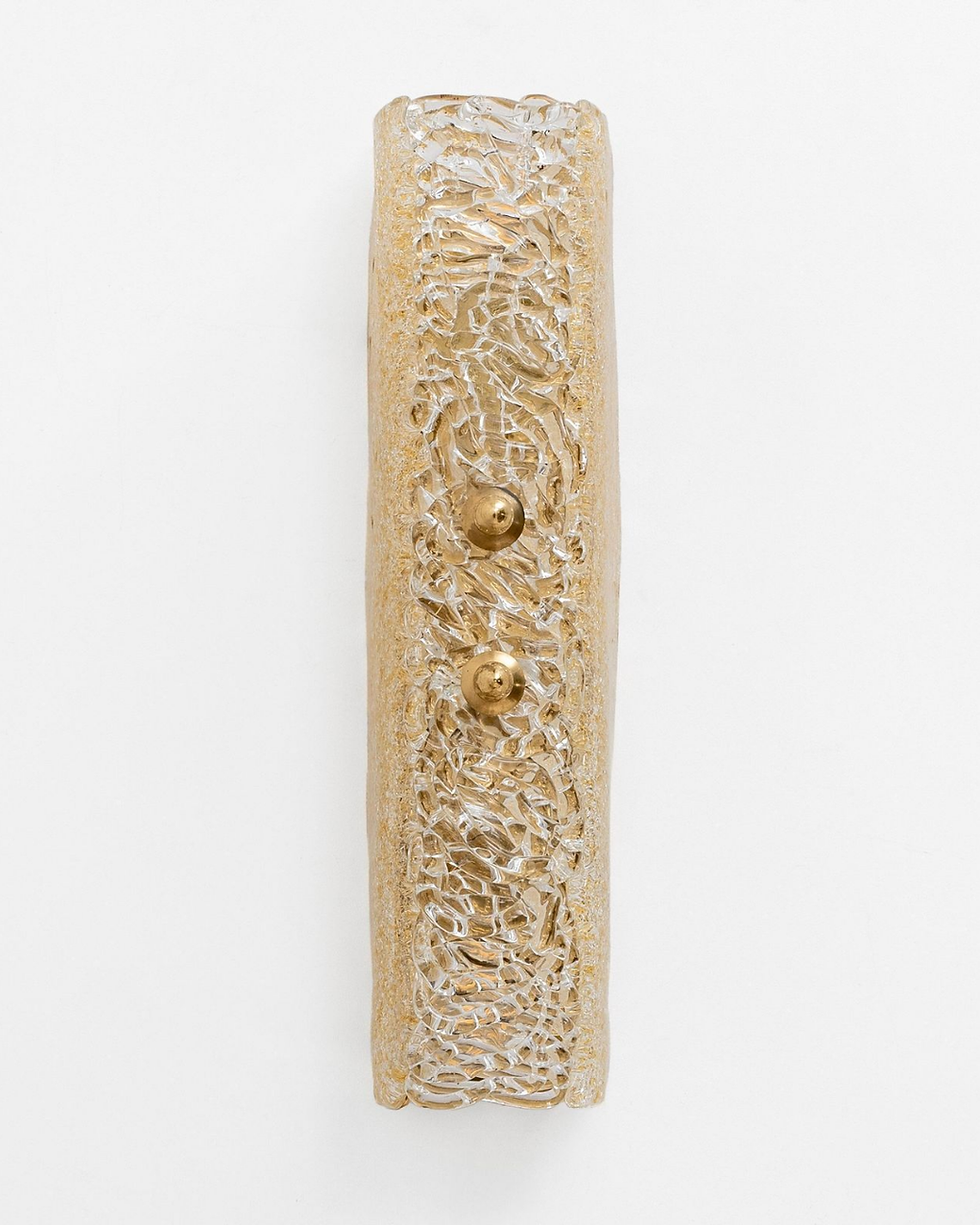
Handblown Murano glass carries the breath of the maker - literally. Each piece is unique because each gathering of glass is unique, each moment of blowing and shaping is unrepeatable. The gold graniglia sconces in Edit No. 5 are warm rather than merely decorative, sculptural rather than simply functional. Against a wall of natural plaster or linen, they hold light in a way that contemporary wall lights rarely achieve.
How to mix antiques with contemporary interiors
The concern clients raise most often is coherence. If everything else is contemporary, won't an antique feel out of place? In our experience, the opposite is usually true. But the approach matters.
Choose form over period.
The best antiques to layer into a contemporary interior are those where the form is essentially timeless - a simple bronze vessel, a hand-thrown ceramic, a piece of joinery built around function. These don't read as belonging to a specific era. They read as objects with an inherent rightness of shape that has simply survived.
Let the material do the work.
An antique mahogany cabinet beside natural stone. A bronze vessel against dark-stained burl. Both natural materials, both carrying the evidence of how they were made. The connection is material, not stylistic - and that is a much stronger relationship than trying to match periods or colours across a room.
Think in layers, not statements.
Antiques don't need to be isolated to work. A room can carry several - a wardrobe that anchors a bedroom, a pendant that defines the ceiling, a rug that grounds the floor, a mirror that catches light on a wall - when they are connected by material logic and allowed to breathe. The risk isn't too many antiques. The risk is antiques with nothing in common, competing for attention. Layer pieces that share warmth, natural origin or quiet scale, and the room reads as collected rather than confused.
Know what to leave out.
The temptation with antiques is to keep going, one more piece, one more find. The rooms that work best usually do the opposite. Three considered pieces with calm space around them will always read better than a room crowded with five. Restraint isn't the absence of character. It's what lets the pieces you did choose actually be seen. This is the real skill in mixing antiques with contemporary interiors, not finding the right objects, but knowing where to stop.
Where to find the right pieces
Vinterior is where we source most of our antique and vintage pieces - for client projects and for our Design Edits. The platform is curated, vetted, and searchable by material, period and style. For London clients, it is the most accessible and reliable starting point, with the depth of stock to support a whole interior rather than a single find.
Beyond that: auction houses (Dreweatts, Chiswick Auctions), specialist dealers at markets like Portobello and Bermondsey, and - for those who travel - flea markets abroad, where the quality-to-price ratio can be extraordinary, and where the act of finding something becomes part of its story.
The key is patience. You are not looking for the perfect piece immediately. You are looking for the piece that will still feel right in ten years - the one that, when someone asks about it, you remember exactly where it came from.
The edit as a whole
Design Edit No. 5 — Slow Luxury — is built around this idea: that a room furnished with objects that have genuinely existed, that were made somewhere, used somewhere, carried through time, has a quality that no amount of new furniture can fully replicate. The bronze urli and the Murano glass sconces are the antique anchor pieces in this edit. Everything around them - the granite side table, the mohair pouffe, the hand-woven rug — was chosen to sit in conversation with that age and that weight, not to overpower it.
Explore the full edit here: kachi-interiors.com/edit-05 →
Kachi Interiors is a London-based luxury residential interior design studio. We work with private homeowners in London and internationally — Explore our services →
Disclaimer: Kachi Interiors is sharing these product ideas for inspirational purposes only. We do not receive any promotional benefit or commission from the suggested retailers or product types. We are not responsible for the quality, availability, pricing, or your satisfaction with any third-party products or orders you may place based on these suggestions. Always conduct your own research before making a purchase.